
How to tune a guitar – step by step
Tuning a guitar takes about a minute once you know the order. Here is the simplest way for beginners, using a tuner instead of your ear.
You can follow along with the free online tuner on this page – it recognises each string automatically.
- For acoustic, classical and electric guitar
- Standard tuning E A D G B E
- Works with the free online tuner
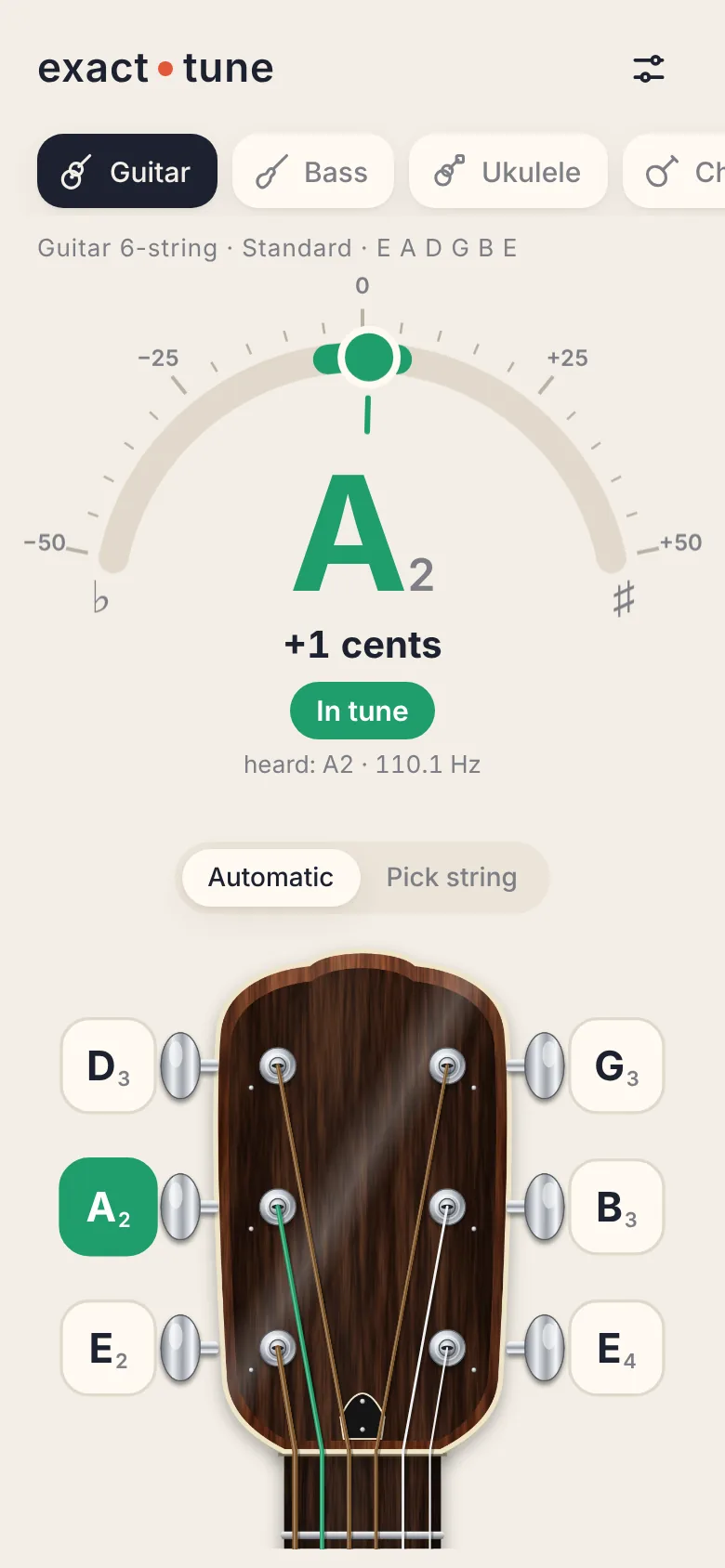
Tune your guitar in 6 steps
- 1
Open the tuner
Start the tuner on this page and allow microphone access. Find a quiet spot.
- 2
Start with the thickest string
Pluck the low E string (6th string) and let it ring. The tuner shows the note it hears.
- 3
Tune up to the note
If the note is too low (flat), tighten the peg; if too high (sharp), loosen it a little and then tune up to the note. Tuning up keeps the string from slipping.
- 4
Wait for green
Stop when the needle is in the middle and the note turns green – within a few cents is in tune.
- 5
Repeat for every string
Continue with A, D, G, B and the high E string.
- 6
Check again
Tightening one string slightly changes the others. Play through all six strings once more and correct small differences.
Guitar string notes and frequencies
| String | Note | Frequency |
|---|---|---|
| 6 (thickest) | E2 | 82.41 Hz |
| 5 | A2 | 110.00 Hz |
| 4 | D3 | 146.83 Hz |
| 3 | G3 | 196.00 Hz |
| 2 | B3 | 246.94 Hz |
| 1 (thinnest) | E4 | 329.63 Hz |
A4 = 440 Hz
Guitar tuning tips
Which direction do I turn the tuning peg?
On most guitars, turning the peg so the top of it moves towards you raises the pitch. If the needle moves the wrong way, turn the other way.
How often should I tune my guitar?
Every time you play. Temperature, humidity and playing all change the tuning slightly.
Why won't my new strings stay in tune?
New strings stretch. Gently pull each string away from the fretboard after tuning and retune a few times – after a day or two they stay stable.